




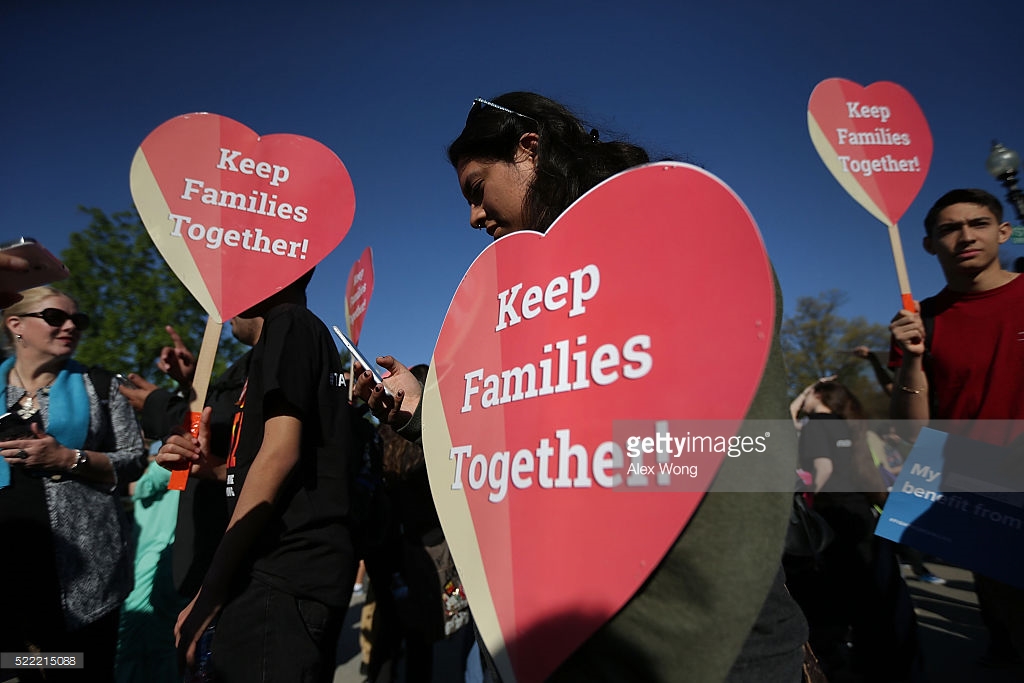
(Photo Credit: Alex Wong)
News Americas, NEW YORK, NY, Fri. April 29, 2016: Oral arguments over the biggest immigration case this century began before the Supreme Court on Monday, April 18, 2016. At issue is whether President Obama overreached beyond his executive powers when granting some relief to an estimated five million undocumented immigrants. At issue is the President’s 2014 Deferred Action for Parents of Americans and Lawful Permanent Residents (DAPA) program and the expanded version of his 2012 Deferred Action for Childhood Arrivals (DACA), which would allow the Department of Homeland Security to “defer” deportation for undocumented children brought by their parents into the U.S. and the undocumented parents of U.S. citizen and permanent residents who have live in the U.S. 14 years continuously and not committed any crimes. Here are ten facts from this hot button case you should know:
1: The case is United States et al versus Texas et al. However, 25 other states have also joined Texas in the case including North Carolina.
2: Gen. Donald B. Verrilli, Jr., is leading the arguments for the federal government. Gen. Verrilli, Jr. is the 46th Solicitor General of the United States and was sworn in as Solicitor General on June 9, 2011, after the United States Senate voted 72-16 to confirm him to the position. Before becoming Solicitor General, he served as Deputy Counsel to President Obama and as an Associate Deputy Attorney General in the Department of Justice. As Solicitor General, he has argued dozens of cases before the United States Supreme Court on behalf of the United States.
3: Also presenting arguments on behalf of the petitioners or in this case the 5 million undocumented immigrants who stand to benefit from DACA and DAPA is Attorney-at-law and civil rights leader Thomas A. Saenz, President and General Counsel of MALDEF, the Mexican American Legal Defense and Educational Fund.
4: A lot of the questions over the law coming from the Conservative justices on the bench, including Chief Justice John Roberts, has so far focused a lot of time on the issue of driver’s licenses. Justice Roberts has been focused on Texas’ claim that it will cost the state government more money to give subsidized driver’s licenses to DAPA recipients who now qualify for them because fees only partially cover the cost of producing a license.
5: But General Verrilli has argued back that “there are vast numbers of people under existing Texas law that are eligible for a license even though they are not lawfully present.”
6: Justice Roberts has also point blank asked General Verrrilli whether “the President (could) grant deferred removal to every unlawful unlawfully present alien in the United States right now?” to which Verrrilli has retorted: “Definitely not.”
7: Asked why, he insisted that because the deferred action has over time, been built up as a set of administrative limits, which has always been for the lowest priorities for removal under current immigration laws and executive powers.
8: However, the Court’s justices must address four key questions in making their rulings. They are: 1) Is it even legal for Texas to sue the federal government to stop the DAPA program?; 2) Is DAPA a substantive new regulation — which the Obama administration didn’t follow the proper procedure for?; 3) Is DAPA within the president’s authority, or does it encroach on parts of immigration law where Congress has already set down the rules? And 4) Is Obama abandoning his constitutional obligation to “take care” to enforce Congress’s laws by implementing DAPA?
9: Because the seat formerly occupied by the late Justice Antonin Scalia for 30 years is still vacant, the court has just eight justices – four conservatives and four liberals. A tie vote in the court, which appears likely in this case, will not set any precedent, but it will retain the injunction against the President leaving the Department of Homeland Security unable to implement DACA or DAPA.
10: If the Court sides with the states, nothing changes — programs that currently aren’t in effect won’t go into effect. But if the Court sides with the administration, an estimated 4.5 million immigrants who are currently vulnerable to deportation will get three years of protection and the ability to work in the US legally while being able to travel outside of the U.S. as well.