




By NAN Business Editor
News Americas, NEW YORK, NY, Fri. March 27, 2026: The Caribbean is home to a growing number of companies generating hundreds of millions – and in some cases billions – in annual revenue, underscoring the region’s often underestimated economic strength.
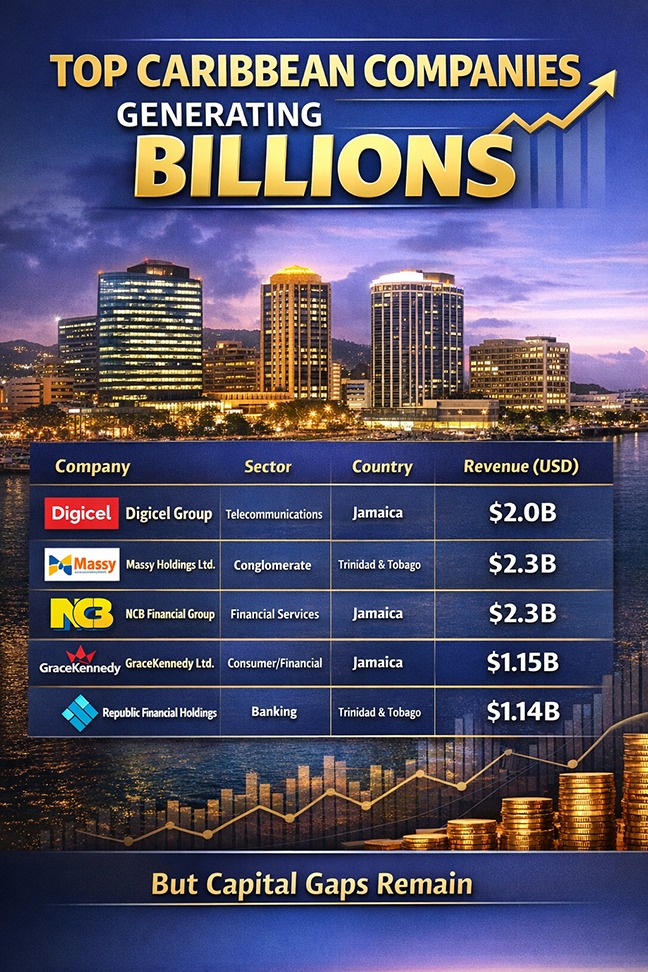
A recent data snapshot compiled by Explaining The Caribbean highlights top-performing firms across telecommunications, banking, manufacturing and conglomerates – revealing a network of high-performing enterprises operating across the region.
From telecommunications giant Digicel, with estimated revenues exceeding US$2 billion, to diversified conglomerate Massy Holdings and Jamaica’s NCB Financial Group, both reporting revenues above US$2.3 billion, the data paints a clear picture: the Caribbean is not a small market – it is a multi-billion-dollar economic zone.
Top Caribbean Companies by Revenue
“The data reinforces a critical but often overlooked reality we have been reiterating since 2011: the Caribbean is not a small economic region – it is a network of multi-million and billion-dollar enterprises operating across key sectors,” said Felicia J. Persaud, CEO of Invest Caribbean and founder of AI Capital Exchange.
However, the data also highlights a deeper structural challenge.
“While established companies continue to scale, access to structured capital for new and mid-sized projects across the region remains uneven,” Persaud added. “The Caribbean is not lacking capital – it is lacking efficient access to capital. At Invest Caribbean, we see this gap every day. Strong businesses. Real projects. But limited access to structured debt capital.”
The Capital Gap
Despite strong corporate performance, many developers, entrepreneurs and growth-stage businesses across the Caribbean continue to face difficulties accessing financing – particularly for large-scale or cross-border projects.
This disconnect between revenue concentration and capital accessibility has increasingly become a defining issue for the region’s economic future.
While large, established firms benefit from existing banking relationships and internal capital flows, smaller and emerging ventures often struggle to secure funding due to risk perception, fragmented markets and limited structured lending platforms.
The AI Question
At the same time, a new challenge is emerging.
As global industries rapidly shift toward artificial intelligence and digital transformation, Caribbean companies face mounting pressure to modernize operations, improve efficiency and remain competitive on the global stage.
“The next phase of Caribbean competitiveness will not just be defined by revenue, but by how quickly companies adapt to AI and digital transformation,” Persaud noted.
“The risk is not that the Caribbean lacks strong companies – it’s that without accelerated investment in technology and innovation, the region could fall behind globally.”
While some financial institutions and telecom firms have begun investing in digital tools and automation, broader adoption across sectors remains uneven, constrained by infrastructure gaps, limited access to capital and shortages in specialized technical talent.
A Defining Moment
As the Caribbean continues to generate significant corporate revenue across key sectors, the region now faces a critical inflection point.
Bridging the gap between capital availability and access – while accelerating investment in AI and digital infrastructure – will be essential to ensuring long-term competitiveness.
Without it, the region risks remaining a collection of strong legacy companies rather than evolving into a fully integrated, innovation-driven economic powerhouse.