



News Americas, LONDON, England, Weds. May 7, 2014: Later this year China will become the world’s largest economy, overtaking the United States roughly five years earlier than was previously expected.
Evidence of this is contained in a recent forecast produced by a relatively little known World Bank related body, the International Comparison Programme (ICP). According to the ICP, China’s economy has been growing rapidly – between 2011 and 2014 by 24 per cent – whereas the US economy, over the same period grew by 7.6 per cent. On this basis, analysts forecast that China will overtake the US economy in size later this year.
China disputes this largely for political reasons, but irrespective, the message is clear: either this year or very soon, it will have to accept the implications of being the pre-eminent world economic power.
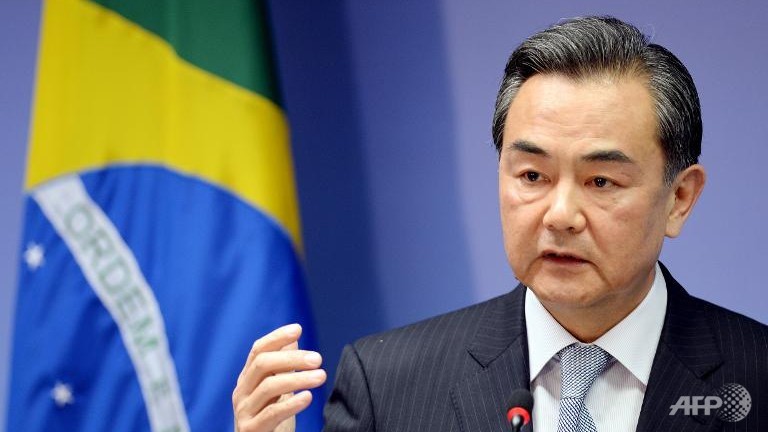
The news comes after a week-long visit to Latin America and the Caribbean by the Chinese Foreign Minister, Wang Yi. During stopovers in Cuba, Venezuela, Argentina and Brazil, he made clear China’s belief in what he described as “the historic inevitability” of stronger co-operation.
Speaking in Brazil, Mr. Wang said that China and Latin America are highly complementary in their development and are “natural partners.”
Mr. Wang also said that the creation of the China-CELAC (the Community of Latin American and Caribbean States) forum earlier this year will create new prospects for China-Latin America relations, and that its members should make joint efforts for the success of the sixth summit between Brazil, Russia, India, China and South Africa, in Fortaleza, Brazil, on July 15-16.
Although speaking in a Latin American context, it is clear that the same policy, which does not appear to differentiate between the two regions, is guiding Chinese thinking about the Caribbean.
Over the last decade China has become an important partner for almost every Caribbean nation. Its engagement is extensive not just in those nations that recognize Beijing, but also in some of those that do not.
In strategic terms, its predominant focus is on Trinidad in relation to the purchase of liquefied natural gas; in Jamaica its interest is in a proposed US$2billion investment in a transshipment port and manufacturing zone; in the Bahamas, it is on the huge Baha Mar hotel project; in Guyana and Suriname it is in exploring road and port projects that would open up the interior and Brazil’s landlocked provinces; in Nicaragua, it is in a new canal across the Central America Isthmus; and in Cuba, with which it politically close, it has multiple investments in the making.
These projects are either funded by the Chinese government, its state-linked banks or by the Chinese private sector, leveraging the support of both, although it is hard to know where the dividing line is.
China’s engagement, at a time when most nations other than Venezuela’s has diminished, is serving to emphasize the region’s value as an economic platform to be utilized for accessing third countries.
The effect is to make other nations think more about the Caribbean.
Firstly, it has stimulated newfound interest in the Caribbean Basin among the Gulf States, the sovereign wealth funds and the businesses of Asia that obtain value from following Chinese investment around the world.
And secondly and paradoxically, it has heightened transatlantic awareness, encouraging the US, Canada and Europe to respond separately and jointly to this change; although it has to be said with some uncertainty, as senior figures on both sides of the Atlantic speak both about the opportunity of working with China while more guardedly wondering about a long term strategic threat.
That said, China’s engagement raises difficult questions which neither China nor the Caribbean seem as yet to be prepared to address.
One lesson that the region’s partners in Europe have now largely learnt is that as much as it might wish to see Latin America and the Caribbean as one region for reasons of administrative neatness, this does not work. To operate successfully in the Caribbean it is necessary for any state or business to recognize that Caribbean sensibilities and responses are not those of Latin America because its history and its consequent cultural and social development has been very different. Put more bluntly, there is a need for China to demonstrate why its approach is developmental and not as some suggest in private, a new form of economic colonialism.
While the region is an ideal platform for transshipment and manufacturing and is interesting from a strategic standpoint, its strong sense of self-identity and independence requires engagement by every partner in a manner that is demonstrably genuine and which passes beyond self-interest.
There is also a real and pressing need for China to address what it has learnt from its early start in Africa and make clear that its mistakes there and subsequently difficult relationships will not be repeated in the Caribbean.
What is also striking, at a time of greater corporate social responsibility, is how little China says about its social role. While it is important for Caribbean Governments to insist on this, rather than simply see much needed investment as an end in itself, the best global investors for instance all undertake impact assessments and go out of their way to understand and be socially supportive of the concerns of everyone from fisher folk to environmentalists.
There is also a need for China to speak less about the total bilateral trade with the Caribbean and more about what it will do to increase exports, joint ventures and employment. It is clear that not only is trade almost all one way – from China into the Caribbean – but that little attempt is being made to develop programs of the kind that Europe and North America undertake to foster enterprise-led exports, tourism and services ventures.
In the end, the biggest challenge will be for China to establish a cultural affinity with the Caribbean. This is not about teaching Chinese or programs that try to have the region understand China.
While these are of value, it is about the reverse. It is about demonstrating that the Caribbean and its culture matters and that what is now happening is about more than the region being a servant of Chinese investment.
This is not to be critical of the important role that Chinese development through investment has to play. Rather it is to suggest that the responsibilities that follow from being the world’s largest economy require China to achieve a better and Caribbean-specific understanding of the region’s values, culture and history.