


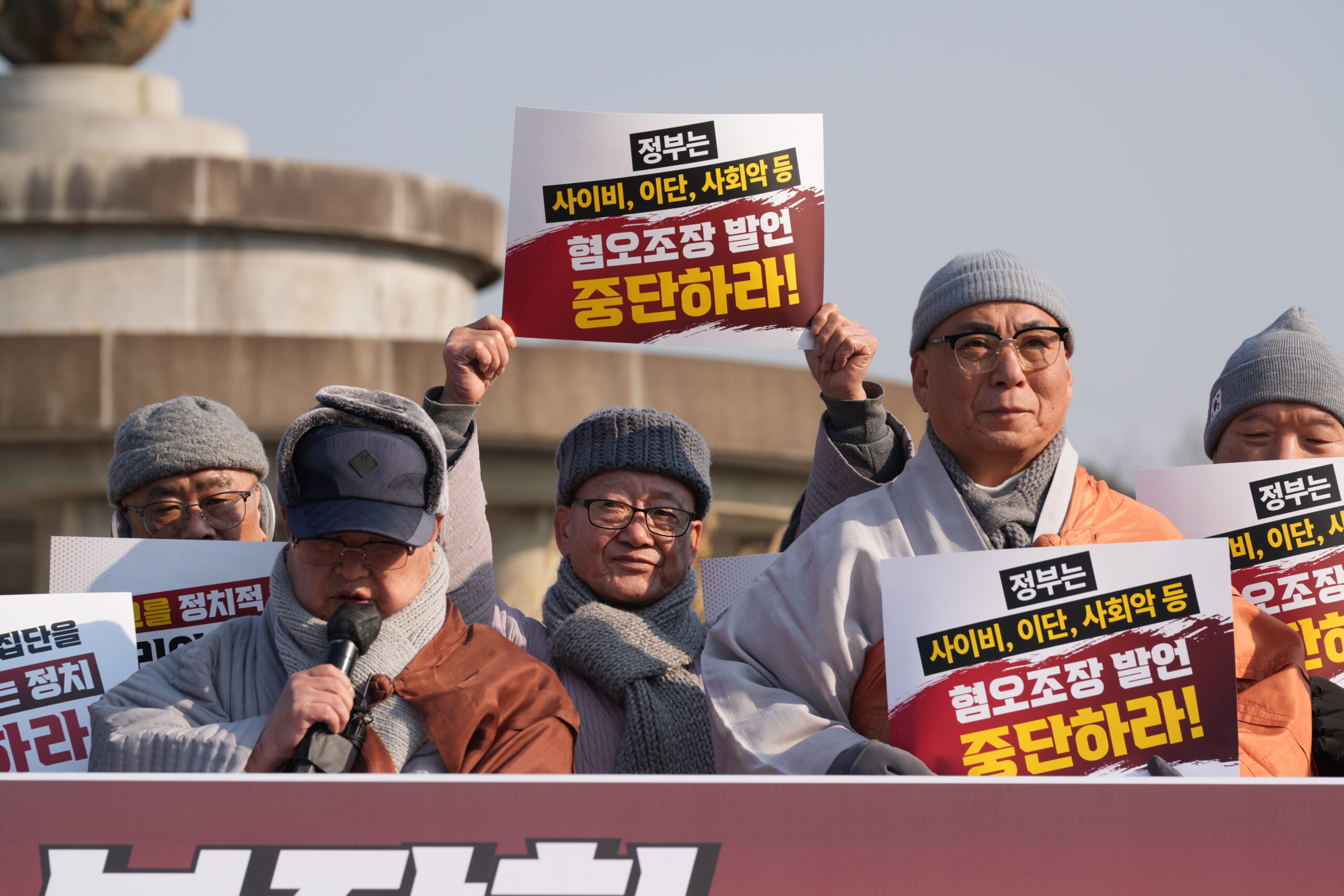
News Americas, Seoul, South Korea, Mon. February 2, 2026: The Coalition for Democracy and Freedom of Religion, (CDFR), a civil society alliance, held a joint press conference in front of the Blue House fountain in Seoul, South Korea, releasing a statement criticizing recent remarks and investigative directives issued by senior government officials.
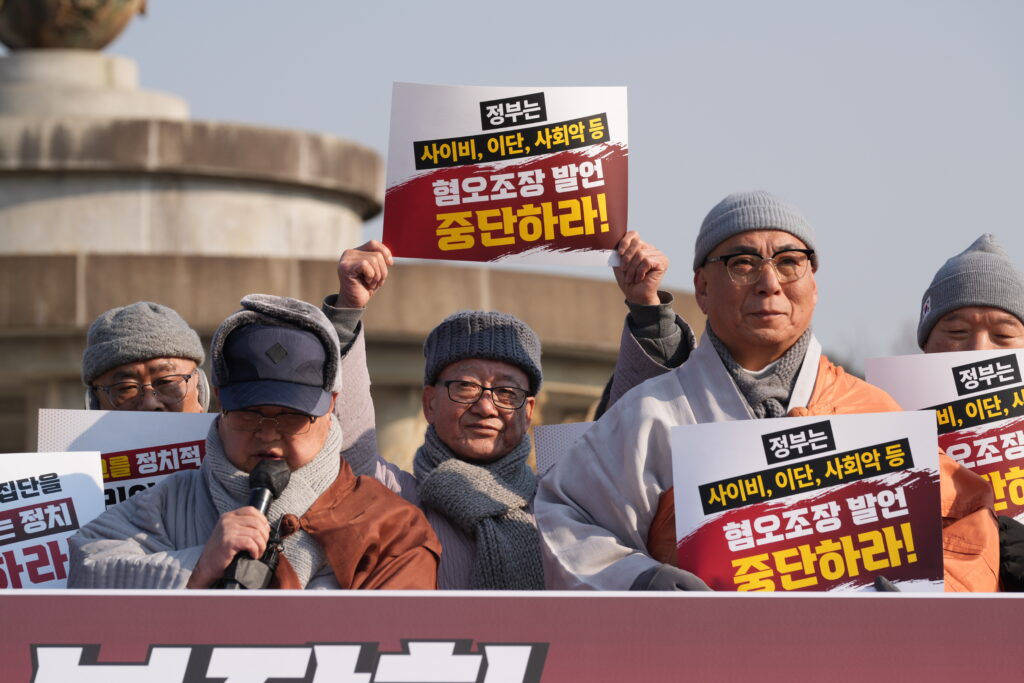
Through the press conference, the Coalition officially announced its launch and stated that “state-level stigmatization and pressure targeting specific religions raise serious concerns about undermining the freedom of religion and the constitutional principle of separation of religion and state.” CDFR is a coalition composed of civic, religious, and social organizations in South Korea, with participation from a broad range of figures, including religious figures representing Buddhism, Christianity, Islam, as well as legal professionals, university professors, and leaders of civil society organizations.
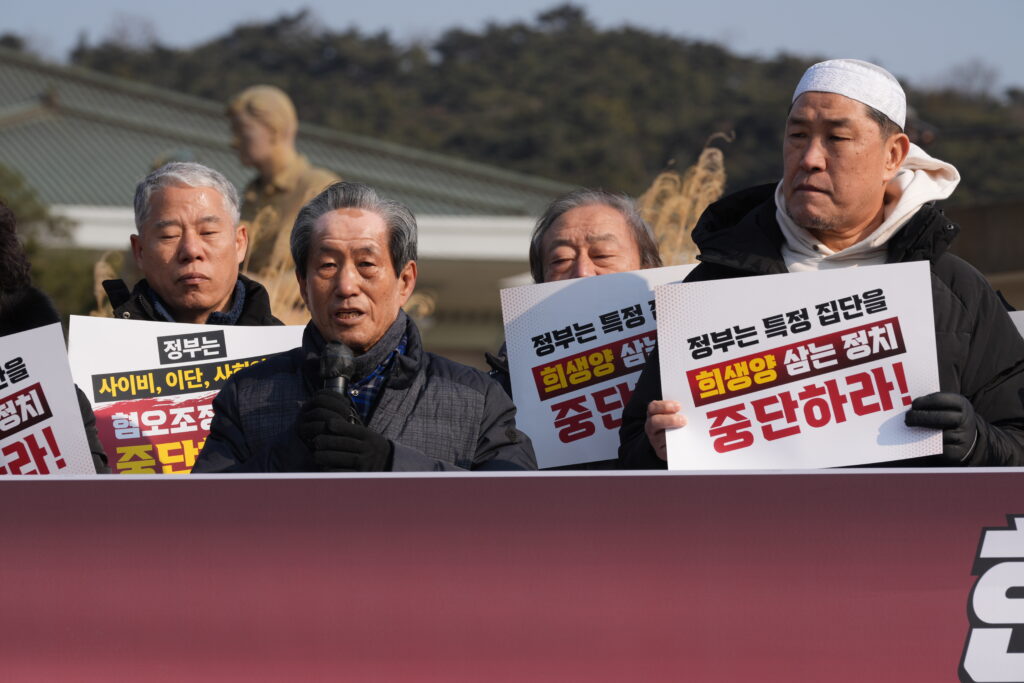
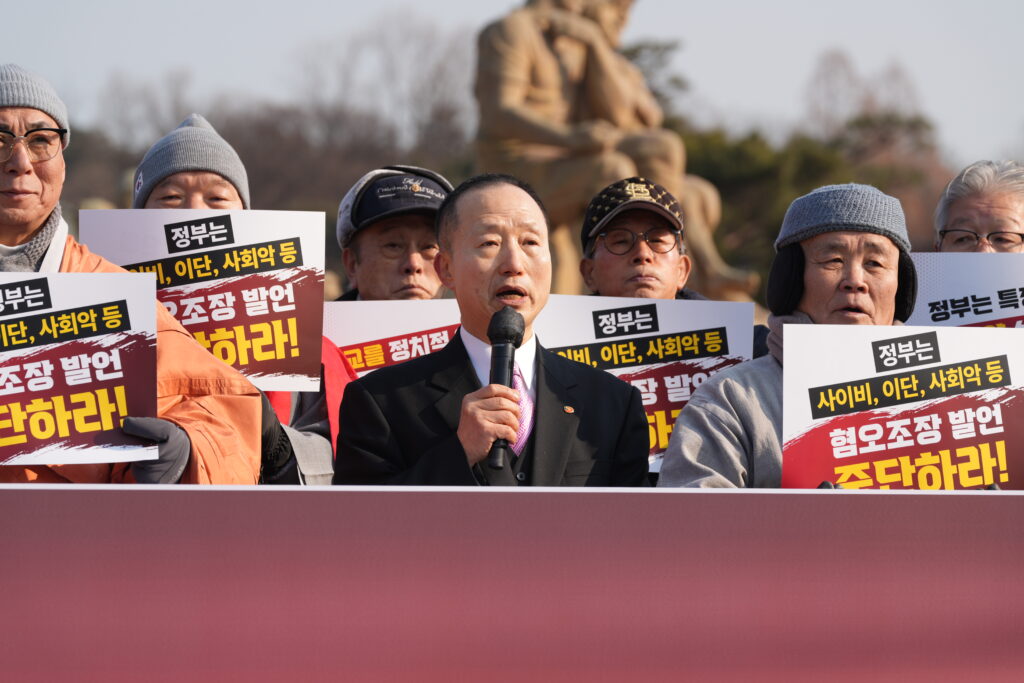
The event, titled “Joint Press Conference for the Protection of Constitutionally Guaranteed Freedom of Religion,” drew approximately 100 participants and featured the reading of a joint statement followed by keynote presentations from the Coalition’s co-representatives. The statement was read by Ven. Beop San, the executive chief of the Jogye Order of Daegak Buddhism and a co-representative of the Coalition. This was followed by presentations from four speakers representing Buddhist, Christian, and Islamic communities, as well as civil society, who addressed the potential impact of government labeling specific religions on constitutional order and democratic principles.
In its statement, the Coalition cited Article 20 of the Constitution of the Republic of Korea, which guarantees freedom of religion and mandates the separation of church and state, as well as Article 10 (human dignity) and Article 11 (equality before the law). The Coalition argued that repeated official references to certain religions as “pseudo-religious,” “heretical,” or “harmful” risk creating tension with the principles of religious neutrality and non-discrimination required in a democratic society.
The statement was prepared following a January 12, 2026 luncheon meeting between President Lee Jae-myung and religious leaders, during which, according to the Blue House Spokesperson Kang Yoo-jeong briefing, the President expressed agreement with remarks by some religious leaders stating that “the damage caused by pseudo-religious and cult groups such as the Unification Church and Shincheonji is severe,” adding that “the harm has grown because it has been left unchecked for too long in our society.”
The following day, Prime Minister Kim Min-seok, during a Cabinet meeting, described the Unification Church and Shincheonji as “social evils that must be eradicated,” ordering a comprehensive, government-wide joint investigation and response. These remarks were cited by the Coalition as representative examples of the issue at hand.
At the press conference, the Coalition stated that “regardless of whether criminal allegations are under investigation, the practice of senior government officials broadly defining specific religious groups in negative terms risks undermining the state’s obligation of religious neutrality.” It further argued that the progression from opinions raised at a religious leaders’ meeting to strong language delivered at a Cabinet meeting could lead to misunderstandings regarding the constitutional principle of separation of church and state. Some observers have also noted that, despite certain religious organizations’ documented participation in volunteer work, blood donation campaigns, and other forms of social engagement, they have been subject to sweeping negative characterizations without the presentation of specific criminal findings.
Emphasizing that South Korea is a state party to the UN Charter, the Universal Declaration of Human Rights, and the International Covenant on Civil and Political Rights, (ICCPR), the Coalition stated that “recent government responses warrant careful examination as to whether they align with international human rights standards.” The Coalition called on the United Nations (UN), and organizations dedicated to freedom of religion or belief, democracy, and human rights worldwide to conduct independent reviews and issue official statements, including recommendations, regarding whether the current situation in South Korea complies with constitutional values and international norms.
In closing, the Coalition urged the government to cease all actions that incite hatred toward particular religious groups and that wrongfully wield state power; issue a public apology for discriminatory remarks made by the President and Prime Minister and pledge to prevent any recurrence; and establish communication frameworks that ensure equal respect for all religions and beliefs. “Freedom of religion is not an issue concerning a single group,” the Coalition emphasized, “but a fundamental standard for the entire democratic society.”