By NAN Staff Writer
News Americas, CHARLESTON, SA, Mon. June 22, 2015: Hundreds flocked into the Emanuel African Methodist Episcopal Church in Charleston, South Carolina Sunday as Sunday service resumed for the first time since the June 17th killings of nine congregants by a 21-year-old man apparently driven by hate. But as the focus shifted to speeches of forgiveness and calls for change, lost in the mix was the Caribbean link of this 199-year-old ‘Mother Emanuel’ Church.
Much is spoken of one of the church’s founders Denmark ‘Telemaque’ Vesey but missing from the news reports is the fact that he was born in the Caribbean.
Vesey was born Telemaque into slavery about 1767 in St. Thomas, U.S.V.I. at the time the island was a colony of Denmark. Telemaque was purchased at about age 14, historians say, by Joseph Vesey, a Bermudian sea captain and slave merchant.
He was then sold to a planter in French Saint-Domingue or modern-day Haiti. After Telemaque was found to suffer from epileptic fits, Vesey took him back and returned his purchase price to the former master.
Telemaque then worked as a personal assistant and interpreter in slave trading to Joseph Vesey, including periods spent in Bermuda, and was known to speak French and Spanish in addition to English. Following the American Revolution, the captain retired from the sea and slave trade, settling in Charleston, South Carolina.
Telamaque had learned to read and write by the time he arrived in Charleston, and was already fluent in French and English. Vesey “hired out” Telemaque as a skilled carpenter, and he joined other artisans in the city, many of them free people of color who had their own community in the city.
On November 9, 1799, Telemaque won $1,500 in a city lottery. At the age of 32, he bought his freedom for $600 from Vesey. He took the surname Vesey and the given name of Denmark, after the nation ruling his birthplace.
He then began working as an independent carpenter and built up his own business and married an enslaved woman. Vesey worked to gain freedom for his family, and tried to buy the freedom of his wife but her master would not sell her. This meant their future children would also be born into slavery.
Vesey went on to help start Hampstead AME Church downtown and agitate for others’ education and freedom. The violence perpetrated by whites against blacks – attacks both legal and physical, including assaults on the church – convinced him that rebellion was justified.
Vesey and his co-conspirators plotted insurrection but were exposed by informants. The rebellion struck such fear into the hearts of the white minority at the time, they insisted on answering it with brutality and newly organized militias to keep the city’s blacks under control.
Vesey and five other alleged organizers were executed after a secret trial, and the original church was burned down by white supremacists. In 1834 all-black churches were outlawed in Charleston, and the congregation had to meet in secret until the end of the Civil War in 1865.
In the 1990s, African-American activists in Charleston proposed erecting a memorial to Denmark Vesey, to honor his effort to overturn slavery in the city. The proposal caused much controversy, as some people did not want to memorialize him; others believed a memorial to him not only marked his leadership but would demonstrate that slaves were not happy with their lot.
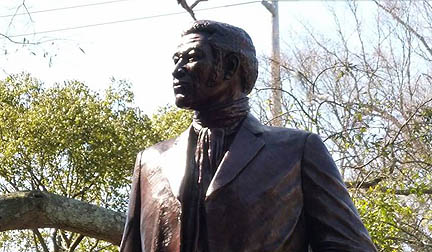
But in February 15, 2014, a statue representing him as a carpenter was finally erected in Hampton Park, at some distance from the main tourist areas. At the time of the statue’s unveiling, the New York Times ran an op-ed under a headline that read: ‘Abolitionist or Terrorist?’