




News Americas, TORONTO, Canada, Weds. Oct. 8, 2014: U.S. policy regarding drugs in Latin America has tended to be pursued with the typical bravura, loud bangs, and distinct lack of forward planning or regard for the indigenous situation for which the USA is famed. While the approach has been heavy, and wanted for nothing in the way of flashy equipment, it has been notably lacking as regards research into causation, societal influences on the drug trade, and the more oblique trends to which the trade is subject. The results are just what could have been expected from such an approach. Although US-funded and supervised measures have certainly changed the face of the Latin American drugs trade, it has not necessarily done so for the better.
Heavy Measures
It cannot be denied that the Americans really are trying very hard to get a handle on the Latin American drugs trade. They have instigated and overseen such extensive measures as flying planes over coca fields in the southern Andes in order to fumigate and kill the crop with ‘Round-Up Ultra’. They have brought in thousands and thousands of extra police briefed specifically to crack down on narcotics, and have brought their military might to bear on the situation with considerable firepower. However, despite this, the Latin American drugs trade still thrives. Of course, the US presence in the ‘war on drugs’ has made a difference – how could it fail to? – but that difference is not necessarily always a positive one.
Fumigation And Dispersal
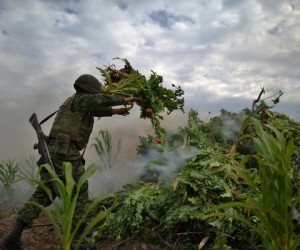
Take the aerial fumigation, for example. That it kills coca crops is undeniable – but this by no means halts the cocaine industry. While it has produced a modest drop in the amount of coca grown in Colombia, dedicated farmers have many means by which they can reduce the impact of the chemicals sprayed on their crops. Perhaps more worryingly, such overarching policies tackle only the product – not the human root of the problem. Thus, rather than being concentrated in one area, fumigated farmers disperse. Like a metastasized cancer, they spread out into the rest of the continent, making the problem as a whole much harder to locate and eradicate. This dispersal has also been proven to destabilize society and contribute to the increase of internal tensions and conflict. Furthermore, the chemicals used during the fumigation present a deadly biohazard to one of the most preciously biodiverse and beautiful habitats on earth – as well as possibly being a considerable threat to human health in the affected regions. Naturally this does not promote goodwill within the region, and brings about an ‘us vs them’ attitude in which, sadly, the ‘us’ is the drugs industry.
Changing The Focus
This is a great shame, because what the US is trying to do should, theoretically, benefit Latin America enormously. Drug addiction is a huge problem for many South American countries, causing both the personal breakdown of people’s lives, and societal breakdown on a wider scale as people turn to crime and cartel involvement in consequence of their habit or in order to fund that habit. Unsanitary drug-taking procedures are ravaging the health of the continent, and effective rehabilitation initiatives and treatment centers are sorely lacking. Drug cartels promote social and political instability, and their activities have claimed hundreds of thousands of lives. Were the ‘war on drugs’ to be won, Latin America would undoubtedly become a much more peaceful, secure, and generally healthy part of the world. However, the US’s policy of engaging with the problem on a militaristic rather than a human level appears merely to be exacerbating the issue. The simple truth is that, while there remains a market for drugs, the drugs industry will continue to thrive.Perhaps the best way in which the US could help to improve the situation is by plunging their funds into education and rehabilitation programs, which would enable the people of Latin America themselves to turn against drugs and the drugs industry. Treatment programs in particular would eliminate much of the residential market for drugs, and would also promote goodwill towards the anti-drugs brigade. As such, rather than being seen as heavy-handed outsiders whose actions contribute to the destabilization of the social and political fabric, American-sponsored anti-drug agents could come to be considered as essential community aids, helping to stabilize and restore Latin American society. This would, in time, help to prevent the civilian aiding of guerilla cartels