




News Americas, NEW YORK, NY, Tues. July 22, 2025: There are moments in a nation’s story when the right question, asked by the right mind, at the right time, has the power to open new doors in education. Dr. Nadine Bryce’s recent Fulbright award is one such moment. Her research returns to Jamaica like a river returning to its source, carrying with it decades of academic excellence, a deep love for home, and an urgent mission: to reimagine how history is taught in Caribbean classrooms. Her guiding question, simple yet profound: How can teachers and students transform the curriculum through disciplinary literacy in history to build in problem-solving, inquiry, and active learning? – rings like a bell calling educators, leaders, and learners to gather and listen.
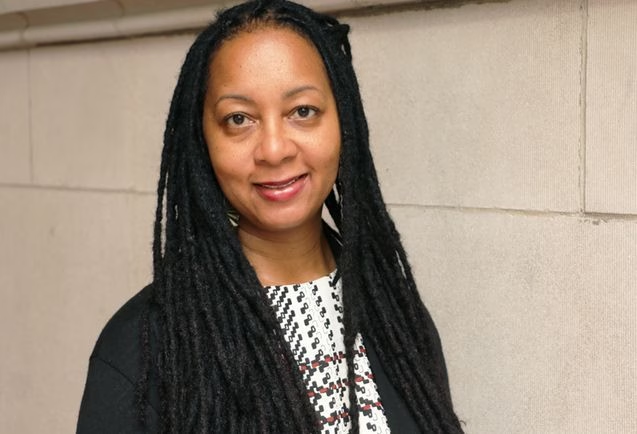
I have known Dr. Bryce for over 30 years, walking beside her in spaces like Harvard and Columbia, where we both learned to challenge outdated models and dream beyond borders. What has always distinguished her work is its ability to breathe life into theory and restore soul to curriculum. Her study seeks to shift history from static memorization to dynamic engagement. No longer is history a collection of dead facts. Under her vision, it becomes a living, breathing story that invites students to think like historians, to question, to examine, and to create meaning from the layered experiences of the past.
In a world where so many historical stories are being buried or rewritten, this study is both resistance and resurrection. It arrives at a time when young minds are hungry for connection, meaning, and truth. It also meets a rapidly changing global workforce that no longer asks what students know but what they can do with what they know. Artificial Intelligence has rewritten the rules, and rote learning is no longer enough. Today’s students must be flexible thinkers, ethical problem-solvers, cultural interpreters, and courageous innovators. This study answers that call by grounding 21st-century skills in the rich soil of historical understanding.
Dr. Bryce’s approach honors the classroom as a sacred space of transformation. Teachers are not mere transmitters of content but architects of wonder. Students are not empty vessels but co-creators of knowledge. Lessons become journeys, not lectures. A Jamaican child no longer just memorizes the dates of the Maroon Wars but investigates their significance, analyzes the power dynamics, connects it to modern resistance, and learns to stand taller in their identity. A Barbadian teenager is not just tested on the sugar economy but asked to explore its legacy and imagine new economic futures. In this model, education becomes personal, political, and profoundly liberating.
What makes this work especially valuable is what it offers to those shaping and supporting education today. For policymakers, it is a call to fund and protect culturally relevant curricula that build thinking citizens. For school leaders, it is a blueprint to support teachers with training in disciplinary literacy and inquiry-based learning. For teachers, it offers a model that reignites purpose and invites creativity. For parents, it encourages a deeper partnership with educators in shaping critical thinkers and culturally rooted learners. For students, it unlocks the door to curiosity, confidence, and real-world readiness. This is important research dancing along a roadmap to renewing how nations teach, think, and thrive.
Dr. Nadine Bryce’s Fulbright journey combines celebration of academic achievement with the unfolding of a vision rooted in the Caribbean’s wisdom and launched toward the future. It tells us that history does not have to be a shadow we walk through but a light we carry forward. It reminds us that when we teach history as a mirror and a window, we allow students to see themselves as part of a much larger narrative, one that began long before them, and will continue long after them, shaped in part by the choices they make today. In giving students the tools to question and the courage to speak, Dr. Bryce’s work helps us all remember: when history speaks, the future listens.