


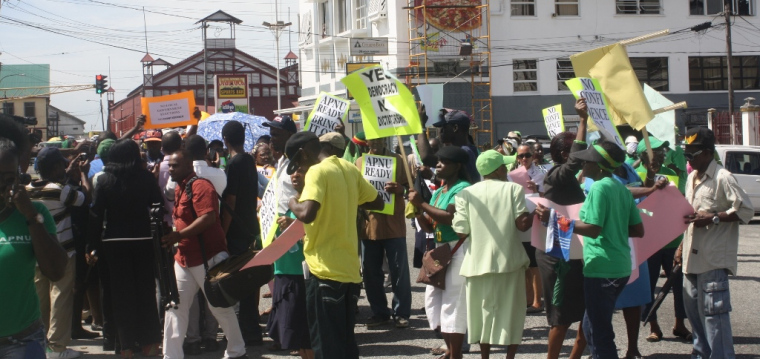
News Americas, GEORGETOWN, Guyana, Thurs. Nov. 20, 2014: Calls by Dr. Rupert Roopnarine and Ms. Lurlene Nestor, members of the opposition A Partnership for National Unity (APNU), for boycott of the Guyana Times and the State media and businesses that aid the PPP’s authoritarian rule respectively have drawn swift and sustaining vitriol from the PPP, its sympathizers , Guyana Times and the State media. Why this outcry from the PPP and its friends over two routine non-violent calls to action from opposition figures? Boycotts are standard fare in the politics of protest all over the world.
It has been used in Guyana by all parties, including the PPP. Most of the time it is an ineffective tool of mobilization; it serves more as a threat against opponents. So why is the PPP making a big deal over these two calls? The answer lies in an understanding of two levels of PPP’ thinking – the sub text behind what appears as normal politics.
The first level is the immediate strategy surrounding the PPP’s prorogation of the parliament. Part of the PPP’s strategy is to use the prorogation to excite the inevitable opposition protest and then portray it to the Indian Guyanese community as violence against them by African Guyanese. This is part of a well-known aspect of the PPP’s historical praxis, which I will explain below. It means that even the most nonviolent action would be portrayed as violent, as part of a violent construct that is central to the PNC’s and by extension African Guyanese violent mindset. So boycott of a newspaper or a business becomes synonymous with violence.
The second part of the PPP’s strategy is aimed at the AFC and other Indian Guyanese leaders. The plan is to use Indian Guyanese leaders’ participation in the opposition protest to portray them as non-Indian—the other, the traitor to the racial collective. So Dr. Roopnarine is ridiculed as “aging revolutionary” and “Cambridge educated” – the Indian mimicking the Black Revolutionary and the Anglo Saxon. AFC’s Indian Guyanese leaders, Khemraj Ramjattan and Moses Nagamootoo, former leading PPP leaders, are ridiculed as “rum shop” Indians—low caste. The ‘otherization’ of the dissident Indian in full swing.
The second level of the PPP’s thinking is the larger historical level. The PPP is guided by a grand narrative, which is grounded in fixed assumptions of the social, cultural and political reflexes of African and Indian Guyanese. This narrative constructs Indian Guyanese as passive, clannish and culturally superior and African Guyanese as violent, dictatorial, prone to material inducements and culturally inferior.
Any close study of the utterances of the PPP leadership and its intellectual gurus over the last seven decades would reveal this world view. It is in this context that, for example, the Attorney General’s recent discourse, in what he thought was a private conversation, must be properly understood. It is this narrative that informs those racist editorials that appear in the Guyana Chronicle ever so often and the almost daily reticule of Africaness in the Guyana Times. It is a narrative that has developed over decades and is constantly refreshed by the PPP.
The overriding conclusion for the PPP, arising out of this narrative, is the divine right of the party to govern Guyana. Next, the assumption of the clannish superior Indian leaves no room for the dissident; he or she must be the “other.” Third, African protest arises not out of grievance but out of the inherent compulsion for violence. In fact one Indian Guyanese theorist has argued that it was the constant need to fight back against centuries of slavery and other forms of oppression that has led to the violent reflexes of the African in Guyana and the Caribbean.
The PPP has been able to get away with this kind of political thinking and action largely because it has been successful at masking its true self. It has been successful at painting the PNC to the society, as the extension of an inherent authoritarian and violent collective. The PNC’s dictatorial rule is explained not as part of our Caribbean post-colonial authoritarian excesses but as part of a Black authoritarian collective personality that makes electoral rigging and dictatorial rule normative. It is why the most punitive action by the PPP such as suspending parliament without just cause is explained in constitutional terms. A PPP government is simply incapable of dictatorship.
Finally, it has successfully amplified African Guyanese violence against Indian Guyanese and silenced Indian Guyanese violence against African Guyanese. So no matter how much the African Guyanese leadership plead its embrace of non-violence or avoid public protest altogether, any suggestion of protest is portrayed as violence or imminent violence.