


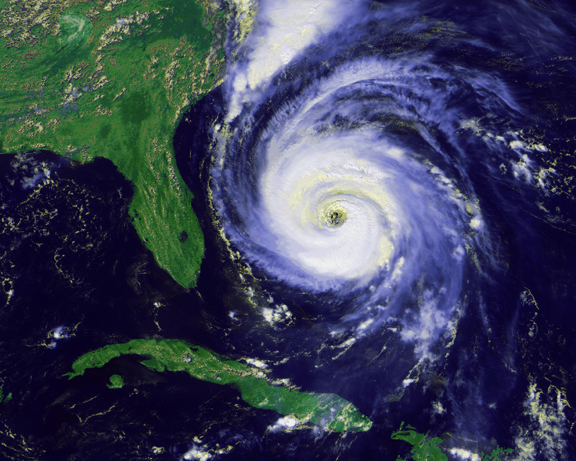
News Americas, NEW YORK, NY, Weds. Sept. 27, 2017: Basically, hurricanes are nothing but a subset of tropical cyclones that form in the Atlantic Ocean and eastern part of the Pacific Ocean. Hurricanes, or any other tropical cyclones for that matter, are among the most devastating natural calamities as they have the potential to cause large-scale destruction through a deadly combination of mighty winds, storm surges, and heavy rainfalls. Additionally, all tropical cyclones, including hurricanes, not only form but intensify over the warm oceans of the tropics under certain favorable conditions.
First and foremost, when we say favorable conditions, we are referring to the availability of a very large water body like an ocean or sea with a minimum surface water temperature of 26°C. The warm ocean water is a key ingredient that provides a tropical disturbance and the energy hurricanes require to elevate itself. This is the reason why tropical cyclones usually form only over oceans close to the equatorial region. The second requirement for the formation of a tropical cyclone, specifically a hurricane, is the availability of winds that don’t fluctuate a great deal in both speed and direction while ascending in the sky. The third necessary condition is the presence of the Coriolis force, which supplies torque. The fourth condition is the existence of a low-pressure area over the water body and finally, the fifth necessary condition is the requirement of an upper divergence above the respective water body.
Although hurricanes usually begin humbly as a tropical disturbance, they slowly acquire enough energy to become a tropical depression before amassing sufficient energy to intensify as a tropical storm. Once the tropical storm acquires enough energy to reach a wind speed of 119 km/hr or 74 mph, it is then reclassified as a hurricane.
When all the necessary conditions are met, the air over the warm ocean (close to the equator) becomes heated and begins to ascend. As the air rises, it sucks up the particles from the lower surface thereby resulting in an area of lower air pressure directly below the rising air. This causes the air from the surrounding high-pressure regions to swirl-in to fill this “vacuum”. At the same time, the ascending air cools down with height, leading to the formation of clouds. Due to the heat released by the condensing air, more air becomes heated and rises. Thus, a process of indefinite warming and cooling begins. As this process continues, the whole system of air swirls and clouds grows exponentially. Due to the presence of the Coriolis force, the subsequent storms formed in the northern hemisphere spin counterclockwise in accordance with Ferrel’s law. With the increasing energy being released through the condensation of more rising air, the storm rotates even faster leading to the formation of what we refer to as hurricanes.
Once formed, hurricanes follow the path of least resistance. That is, they move west across the Atlantic Ocean, which is why we rarely witness any hurricanes on the western coastline of the U.S. Once the hurricanes make landfall, the energy supply as a result of the condensation from the rising air ceases and the hurricanes begin to wane.
Unfortunately, there is no current technology available to stop hurricanes. But once they do make landfall, we can only focus on rebuilding and being charitable toward our fellow man. And although many organizations and kind-hearted people interested in helping hurricane victims like the famous poker player Barry Greenstein have come forward to be a part of such rebuilding efforts, before hurricanes strike, a lot can be done as precautionary measures.
First and foremost, long-term measures such as planting deep-rooted trees on the shorelines can act as the first line of defense. Another long-term measure is to build resilient infrastructure. Even if these long-term measures mitigate the impact of hurricanes are carried out, some necessary measures shouldn’t be avoided. In addition, it is imperative to take heed of government warnings, make a plan for an evacuation, and keep necessary items on hand. Even if you plan to stay at home in the event that an evacuation is not necessary, make sure you keep adequate supplies for at least a week. Because in the end, when it comes to hurricanes, there are no other options but to just be prepared!