


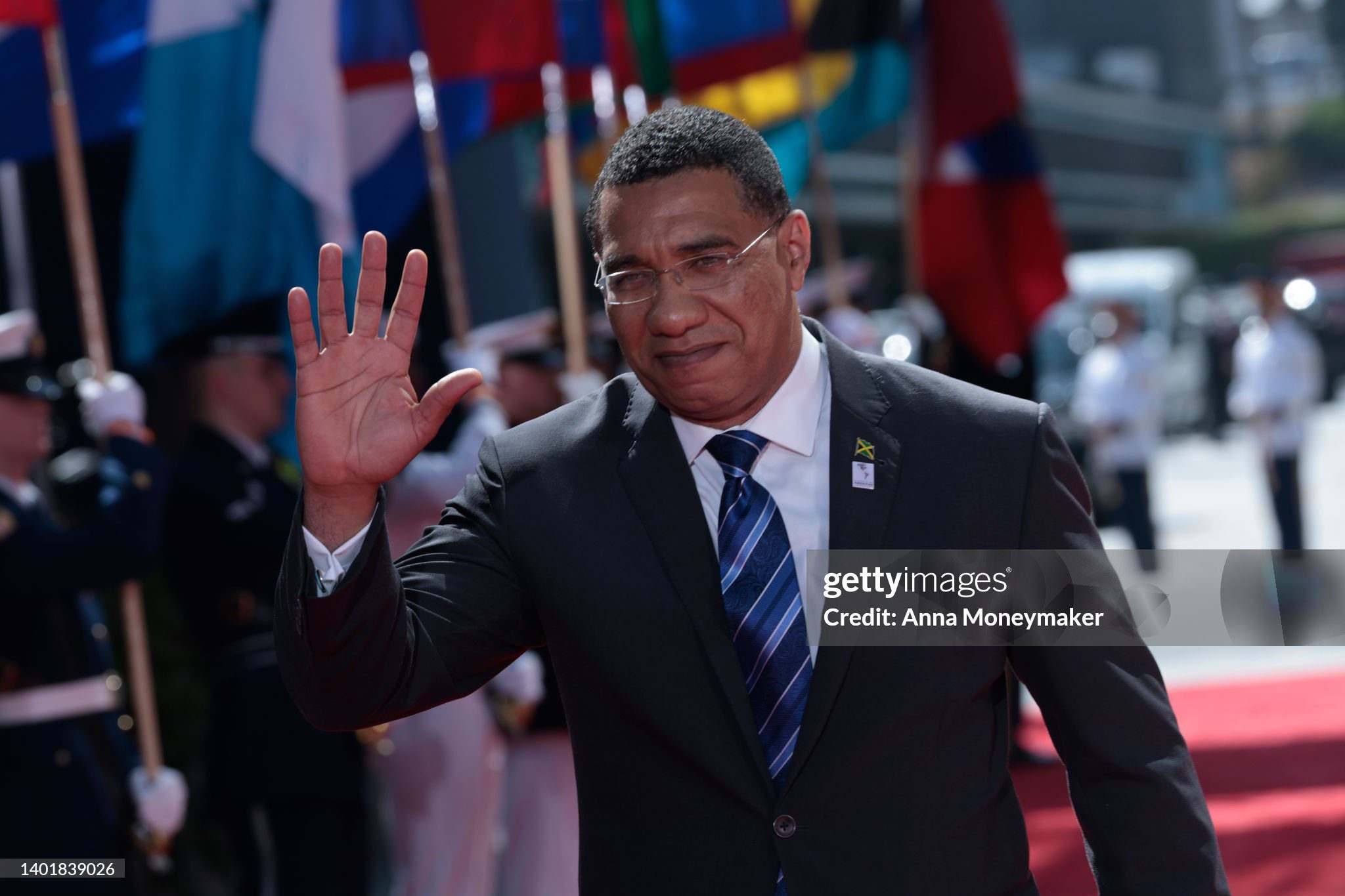
News Americas, KINGSTON, Jamaica, Sept. 4, 2025: Andrew Holness has made history by becoming the first Jamaican leader to secure three consecutive terms in office following yesterday’s September 3rd election, even as his Jamaica Labour Party, (JLP) saw its parliamentary dominance sharply reduced amid a strikingly low voter turnout.
Preliminary results from the Electoral Office of Jamaica, (EOJ), show the JLP captured 34 of the 63 seats in the House of Representatives, compared to the 29 won by the opposition People’s National Party, (PNP). The margin, while enough for Holness to return as prime minister, represents a significant erosion from 2020, when the JLP held 49 seats against just 14 for the PNP.
The EOJ reported voter turnout at just 39.5 percent — slightly above the pandemic-affected 2020 figure of 37.9 percent, but far below Jamaica’s historic high of 78.4 percent in 1980. Analysts say the combination of voter apathy, disillusionment, and growing concerns about governance played heavily into the muted participation.
Holness Holds His Seat
Holness, 53, successfully defended his St. Andrew West Central constituency, defeating the PNP’s Paul Buchanan with 7,054 votes to 4,953. Buchanan had vowed to unseat the prime minister, who has represented the area since 1997.
In a victory speech to jubilant supporters, Holness described the result as proof that “Jamaica won this election.”
“The majority of the voters decided to choose Jamaica…this was not a victory by default,” Holness said. “It was not an easy victory, this was a fight, but we did not descend into the gutter to fight. We ran a disciplined, focused and well-organised campaign and we proved that we can run a decent campaign and win.”
Holness acknowledged the challenges ahead, warning his party against arrogance in its third term. “This government in our third term must be laser-focused in ensuring prosperity for all Jamaicans,” he said, pointing to peace, education, housing and infrastructure as priorities.
PNP Regains Ground
For the opposition, the outcome marked a partial rebound. PNP leader Mark Golding, 59, who retained his St. Andrew Southern seat by a wide margin, conceded defeat but said his party’s improved performance — from 14 seats in 2020 to 29 — signals a revitalized force in Jamaican politics.
“It is my duty as a believer in democracy to acknowledge the results and congratulate our opponents,” Golding said. “Sometimes it brings big disappointments, but democracy is bigger than our feelings, and I accept the results of the elections.”
Golding called the gains “a step forward” for the PNP and pledged to continue building momentum as Jamaica’s main opposition voice.
Low Turnout Raises Alarm
Observers say the turnout of less than 40 percent underscores a troubling disconnect between Jamaica’s electorate and its political leadership. The island has more than two million registered voters, but barely four in ten cast a ballot.
“This level of abstention reflects deep-seated cynicism about whether elections bring real change,” one Kingston-based political analyst told News Americas. “It’s a warning sign for both major parties.”
In a preliminary report, the OAS Electoral Observation Mission in Jamaica noted “with concern the overall disengagement of citizens in the political-electoral process, as evidenced by the 39.5% rate of voter participation in these elections.”
“This result clearly fell below the expectations of stakeholders with whom the Mission met. This is a situation that must be addressed and remedied,” the report added.
Reacting to the results today, US-based Jamaican national and host of Groovin’ Radio, Ras Clem Humes, told NAN: “I am a little surprised at the results given all the facts and the truth coming out from the IC report and the JLP mishandling of major projects; and then some of the ridiculous statements made by the PM about who is a citizen.”
“I am also concerned about the low voter turn-out, Election Day tactics and the lack of respect some MP’s have for the people of the country,” he added. “The PNP did a good job in pointing out the corruption that’s taking place, but the people turn their eyes and made their choice. Hope they can live with it.”
Canada-based Jamaican, Owen Bonnick, pointed out that the polls had “shown that the election would be tightly contested” and that is likely reflected in the thin margin of the win for the JLP.
Pointing to the low turnout of 39.5%, he said this could have been a result of “a lack of enthusiasm” by many of the voting populace.
Controversy and Denials
Holness’ victory speech also came as the Financial Investigations Division (FID) rejected a false report circulating on social media claiming the prime minister was facing corruption charges. The FID denounced the story as “false, baseless, and malicious,” emphasizing that all investigations are conducted strictly under Jamaican law.
Holness dismissed the rumor as part of the “toughest battle in the Caribbean,” declaring himself “solid as a rock” despite attacks.
Looking Ahead
While Holness hinted at seeking an unprecedented fourth term, he also admitted the party will need renewal to attract fresh talent. “We will not be laying back comfortably in office,” he said.
For now, Holness’ historic third consecutive victory is tempered by sobering realities: a weakened majority, a resurgent opposition, and voter participation near record lows.