




News Americas, NEW YORK, NY, Tues. Aug. 19, 2025: When most people think about Jamaica, paradise comes to mind, and yes, this remains true. Warm beaches, sunshine, good food, and music, pleasure at its finest. While these experiences are available to the thousands of people who visit the island each year, there is a grim reality that is far too common to the 2.8 million people who call Jamaica home in 2024, and even those who continue to reside there in 2025.
That reality is gun violence.
During the years I lived in Kingston, Jamaica, (1985–1999), becoming a victim of gun violence was, sadly, far too common. Whether it was a sibling, a loved one, a close friend, or someone from a neighboring community, violence ravaged many communities and left families reeling from the emotional and psychological pain of losing someone close. So, what has changed, and can anything be done to bring peace to communities plagued by violence?
Since 1963, when there were just 63 total reported murders, the number has gradually increased, peaking in recent years. In 2022, Jamaica recorded 1,508 homicides, a rate of 53.3 per 100,000 people. In 2023, murders fell to 1,393, bringing the rate down to around 49 per 100,000. In 2024, the rate dropped further to approximately 40.1 per 100,000, with a total of about 1,141 homicides, still tragically high, but a decline noticeable, according to official data from The Guardian; World Population Review; InSight Crime.
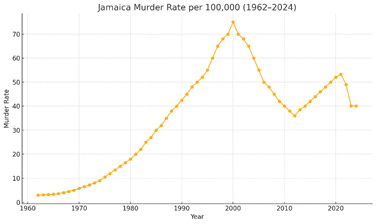
Credit: World Population Review
But the story doesn’t end there. In the first half of 2025, Jamaica has seen dramatic progress. Through June, murder rates have dropped even further, and projections suggest the year could close with a homicide rate near 24 per 100,000, potentially the lowest since 1991, according to the Jamaica Information Service.
Behind every headline, there are stories untold, voices lost in chaos, survivors trapped in cycles of trauma, and families navigating the aftermath of unimaginable loss. Amid the bloodshed, another crisis looms in silence: mental health devastation.
This article seeks to give voice to the families who have suffered. Through their stories, we explore the true cost of gun violence, beyond the statistics, and the urgent need for mental health resources that can help survivors find a path forward.
The Human Cost of Gun Violence in Jamaica
The cost of gun violence in Jamaica is measured not only in lives lost but also in the devastation left behind. Families are shattered, communities are paralyzed by fear, and the economic burden of burial deepens the struggles of an already vulnerable population.
In a country where 12.3% of people lived in poverty in 2023 per Macrotrends, the cost to bury a loved one can range anywhere between JMD 400,000–900,000, a price that can be crippling.
By November 2024, Jamaica had seen a significant decrease in homicides compared to previous years, with total killings around 1,141 for the year according to JIS News. That grim figure doesn’t capture the full human toll. Many families are forced to flee communities, leaving behind homes passed down through generations, just to escape the threat of violence.
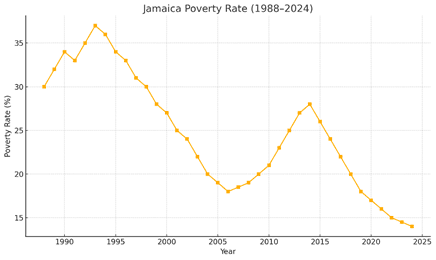
Credit: Macrotrends
A Culture of Fear and Loss
Gun violence has instilled a pervasive culture of fear. Drive-by shootings, assassinations, and gang killings have become commonplace. While laws exist to regulate firearms, illegal weapons continue to flood the island, fueling violence that law enforcement alone cannot contain.
Communities Most Affected
In 2024, St. James led the nation with 117 murders, followed closely by St. Andrew South with 107 killings. These areas, long afflicted by organized crime, have become symbols of normalized violence. For the families left behind, the pain is unrelenting. Gun violence is not just an individual tragedy; it’s a communal wound that festers without justice or healing.
Personal Testimonies: Living With Loss
For many Jamaicans who have lost loved ones to gun violence, the struggle does not end with the funeral. It lingers in their homes, their conversations, and the quiet moments when the absence become unbearable. Most of the people I spoke with agreed: living with loss is an ongoing battle, one that is both emotional and financial.
The rising cost of living, compounded by the sudden expense of burying a loved one, often drives families into crippling debt. Given the country’s poverty rate and widespread low-income wages, a funeral is a cost that leaves lasting scars long after the burial. One person put it plainly: “The cost is large and sets you back.”
But the financial burden is only part of the pain. I wanted to understand how people were coping mentally, how they were navigating the emotional aftermath. For many, however, even imagining a path forward was impossible. Grief was not just sadness; it was war fought within the mind and spirit.
In small, tightly knit communities, news spreads quickly. Often, families learn details about a murder that never make it into official reports. That inside knowledge, whether proven or rumored, becomes a flame that fuels rage and helplessness, especially when the perpetrators remain free, walking the same streets, shopping at the same corner stalls, and living untouched.
“It feels like living with the devil,” one person told me. “The same hands that took your loved one are still out there.”
Another compared it to “living with a fox,” a predator lurking in plain sight, waiting to strike again. This fear isn’t just hypothetical. Many believe that speaking out could make them the next target. And so, they live under a shadow of constant anxiety, silenced not by choice, but by survival.
But trauma doesn’t only belong to those who lost someone. It’s embedded in those who have grown up witnessing violence, who have seen life slip away in real time. One person shared: “When I think about all I’ve witnessed – seeing people fight for their lives, taking their last breath – I can’t help but be traumatized, even years after leaving Jamaica.”
Exposure to gun violence doesn’t affect everyone the same way. For some, the trauma doesn’t take hold until it becomes personal. For others, the effects are immediate, and devastating: a loss of appetite, isolation from friends, or a decision to wear only black, day after day, as a quiet symbol of mourning.
Grief manifests in ways that are rarely spoken about. For many, survival means finding ways to function in silence, to carry pain in their chest while smiling for their children, to walk past the very places where blood was shed and pretend it’s normal.
Another person recounted the horror of watching someone – someone they knew – bleeding out on the ground. “It was very traumatizing because you know some of them,” the person told me. “And to see them lying there, it really affects me. To know that, oh boy, you – Tom – you just gone like that. Why? Just because of gun violence? It’s really traumatizing, of course. And I often think about the days when young guys would just put the guns aside and stop these senseless killings.”
These stories are not unique. They are part of a larger, unspoken reality: the emotional wreckage gun violence leaves behind, scattered across the island like bullet casings.
And yet, amidst all this suffering, one glaring issue remains: the lack of mental health resources to help victims process their trauma. While grief is a universal experience, in Jamaica, those mourning a loved one lost to gun violence are too often left to face it alone, without therapy, without counseling, and without the tools to heal.
This brings us to another dimension of Jamaica’s crisis, one that lives not in headlines but in hearts and minds: the psychological aftermath of trauma, untreated and unseen.
The Psychological Aftermath: Trauma Without Treatment
When I spoke with individuals about the availability of mental health services for victims of gun violence, the initial responses were encouraging, such services do exist. But almost immediately, each person pointed to a deeper problem: government workers do not proactively reach out to grieving families to help.
Grieving families, already burdened by loss and overwhelmed by the financial strain of burial expenses, are expected to navigate their trauma alone. Though counseling is technically free at local clinics and public hospitals, the unspoken expectation is that the grieving must seek out care themselves, even in their most broken state. There is little proactive outreach. No knock at the door. No phone call to check‐in.
“We have to figure it out on our own,” one person told me. “No one comes unless you call. And even then… maybe.”
For many, however, therapy isn’t even a consideration, not because they don’t need it, but because survival comes first. Others are consumed with planning funerals, caring for children, or simply trying to stay safe.
Another theme that surfaced during my conversations deeply unsettled me. Many families, even those who had suffered unimaginable loss, had grown desensitized to the sight of death. In Jamaica, it’s not uncommon for crowds to gather within minutes of a murder, children, teenagers, and adults alike standing amidst the aftermath. Screams. A body on the ground. And yet, once it’s cleared away, life resumes.
“You get used to it,” one person said.
For those who had not lost a loved one, these moments rarely left a lasting mark. But when grief became personal, everything changed.
“I never knew what trauma was,” someone shared. “Never knew what it felt like, until I lost my loved one.”
That moment of realization, when sorrow turns into pain, is where trauma truly begins. And yet, even as people carry deep emotional wounds, they are expected to carry on. Therapy may be technically available, but for many, there is no time, no access, and no cultural space to process what they are enduring.
This is the hidden layer of Jamaica’s gun violence crisis, not the bullets, but the silence that follows them.
It speaks of an urgent need, not only for expanded mental health services, but for a fundamental shift in how the country responds to trauma. If it is to heal as a nation, then the question must be asked: How do leaders create a Jamaica where the wounded are not left to suffer alone?
This brings us to the next step in addressing this crisis: Searching for Solutions, Toward a Safer Jamaica.
Searching For Solutions: Toward A Safer Jamaica
The Jamaican government has adopted a multifaceted approach to curbing gun violence: strengthening law enforcement, enacting a new Firearms Bill, supporting community-based violence interruption programs, and working with international organizations to disrupt the trafficking of illegal weapons.
In a March 19, 2024, UN report, it was noted that “in Jamaica, a concerted effort is underway to tackle a challenge that has long hindered progress and prosperity – the proliferation of small arms and light weapons.”
One such initiative is the Joint Programme on Reducing Small Arms and Light Weapons in Jamaica, launched under the UN-backed “SALIENT” Fund.
Local NGOs have emerged as key players, building grassroots efforts that complement national policy. A standout example is the Violence Prevention Alliance, (VPA), established in 2004 during the University of the West Indies’ Medical Research Conference. Through data-driven analysis and community engagement, VPA aims to understand the underlying causes of violence and prevent its spread.
Still, for many families on the front lines, these efforts feel insufficient. The people I spoke with voiced a recurring concern: law enforcement is not enough. They argued that real change requires addressing deep-rooted inequalities, social, economic, and generational. That means further investments in education, expanding employment opportunities, and alleviating the socioeconomic burdens that leave young people especially vulnerable to gang recruitment and violence.
“Enforcement can only go so far,” one father told me. “We need to give youth a reason to choose something different.”
The consensus was clear: more must be done, not just to stop the bloodshed, but to build a future where violence is no longer the norm.
And yet, even as the country confronts the visible symptoms of the crisis—illegal guns, street crime, economic hardship – a deeper, often invisible wound remains unaddressed: the psychological toll on those left behind.
Breaking The Cycle: The Role Of Mental Health Resources
If Jamaica is to truly address the root causes of violence, breaking the cycle must involve healing the invisible wounds left behind by trauma. For far too long, the psychological consequences of exposure to gun violence have been ignored, treated as secondary to physical safety and policing. But experts and survivors alike are now recognizing a harsh truth: unprocessed trauma can become fuel for the very violence communities are trying to escape.
Trauma recovery programs have the potential to interrupt this cycle. By creating safe spaces where individuals can share their experiences and process their grief, these programs can help reduce the emotional volatility that sometimes leads to retaliation or hopelessness. When people are given the tools to understand and name their trauma, especially among others who have endured similar losses, they begin to see the true weight of what they’ve been carrying.
“Sometimes people don’t realize how deeply they’ve been affected until they hear their own pain reflected in someone else’s story,” a counselor told me.
Local NGOs and community leaders are in a unique position to work alongside state agencies to deliver these programs where they are needed most. But the work cannot stop at treatment, it must also include education. Communities must be informed about the physical, psychological, and social impacts of trauma: the way it isolates, the way it instills fear, and how it normalizes death as an everyday reality.
By building community-based mental health networks, Jamaica can begin to restore trust, dismantle stigma, and offer survivors a path not just to survive, but to heal.
Global Lessons With Local Potential
Across the globe, countries facing similar challenges have found creative, culturally grounded ways to address trauma and rebuild communities.
In Colombia, which has endured decades of armed conflict, community-led mental health interventions were integrated into national peacebuilding efforts, survivors of violence received trauma-informed care alongside job training, social reintegration support, and long-term therapy.
In South Africa, mobile mental health clinics brought psychological services directly into underserved townships. These clinics provided group counseling rooted in shared cultural experiences, helping to break down stigma and make healing more accessible.
Jamaica can draw from these models, tailoring them to the island’s unique needs. The goal isn’t simply to offer therapy, it’s to reweave the social fabric torn apart by decades of violence, restoring hope and resilience where fear once lived.
A Call For Reform
To make this vision a reality, policy reform must prioritize mental health alongside crime reduction. Jamaica needs:
- More trained mental health professionals
- School-based trauma recovery programs
- Mobile counseling units for high-crime areas
- Community centers equipped for group therapy and support groups
- Routine trauma screening in hospitals and clinics
Early intervention is key. Identifying and supporting trauma survivors before their wounds fester into cycles of despair or violence is not only humane, but also a national imperative.
Jamaica stands at a crossroads. The nation can continue to respond to gun violence with force alone, or it can choose a more holistic, sustainable path. One that treats the mind and spirit with as much care as it protects the streets.
Because true safety is not merely the absence of bullets, it is the presence of peace, dignity, and belonging.
Conclusion: Jamaica At A Crossroads
Gun violence has carved deep wounds into the collective psyche of many Jamaicans, leaving not only blood on the streets, but silence in homes, sorrow in classrooms, and fear in the hearts of children.
Behind every bullet is a life cut short, but also a chain reaction: a mother who cannot sleep, a sibling consumed by anger, and a community too traumatized to speak. In our quest to count the dead, we must not forget to see the living – those left behind, navigating a grief that often has no outlet, no language, and no support.
This moment, when homicide rates are projected to fall to their lowest in decades, is not just statistical. It’s an invitation, a chance to decide whether Jamaica endures its pain, or begins to truly heal.
Throughout this journey, I’ve sat with voices that rarely make headlines, those who have suffered in silence, normalized the sight of bodies in the street, and learned to carry loss as a part of everyday life. They are not just statistics. They are the soul of this story.
And they are asking for more than justice. They are asking for healing.
Let us honor the memories of those we’ve lost not only by demanding justice, but by creating systems that prevent the next loss, through mental health care, community restoration, and trauma-informed reform.
Because if change does not begin now, Jamaica risks becoming a country that survives its pain but never recovers from it.
Jamaica deserves more than survival. It deserves healing. It deserves peace. And it deserves it now.
EDITOR’S NOTE: Nyan Reynolds is a U.S. Army veteran and published author whose novels and cultural works draw from his Jamaican heritage, military service and life experiences. His writing blends storytelling, resilience and heritage to inspire readers.