



By Ron Cheong
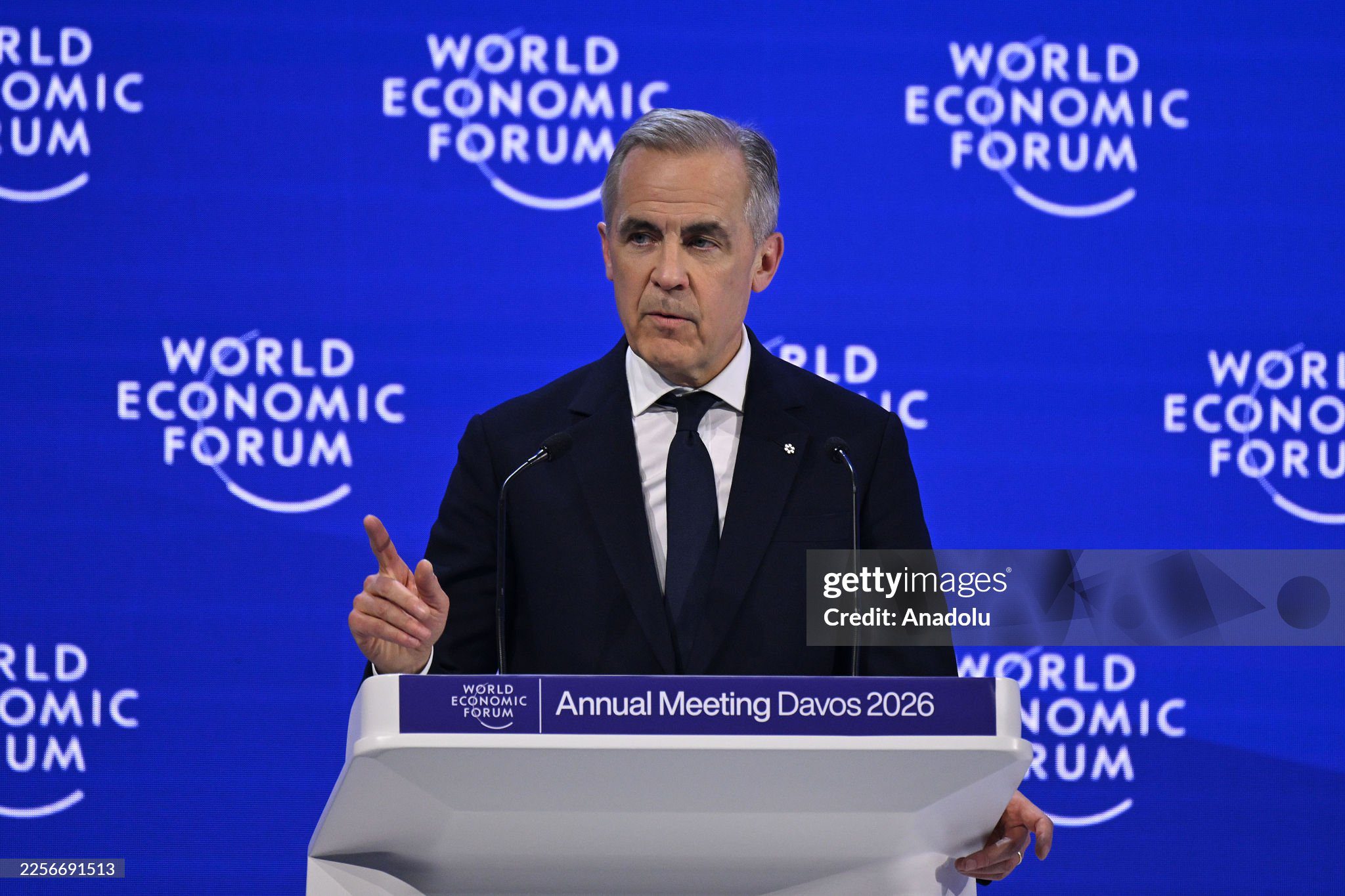
News Americas, TORONTO, Canada, Sat. Jan. 24, 2026: There are moments in global affairs when a speech does more than fill a time slot. It draws a line. It clarifies the stakes. It names the reality that polite diplomacy often tries to soften with euphemisms. Prime Minister Mark Carney’s address at the World Economic Forum in Davos, Switzerland, was one of those moments – brilliant not because it was flamboyant, but because it was uncommonly clear.
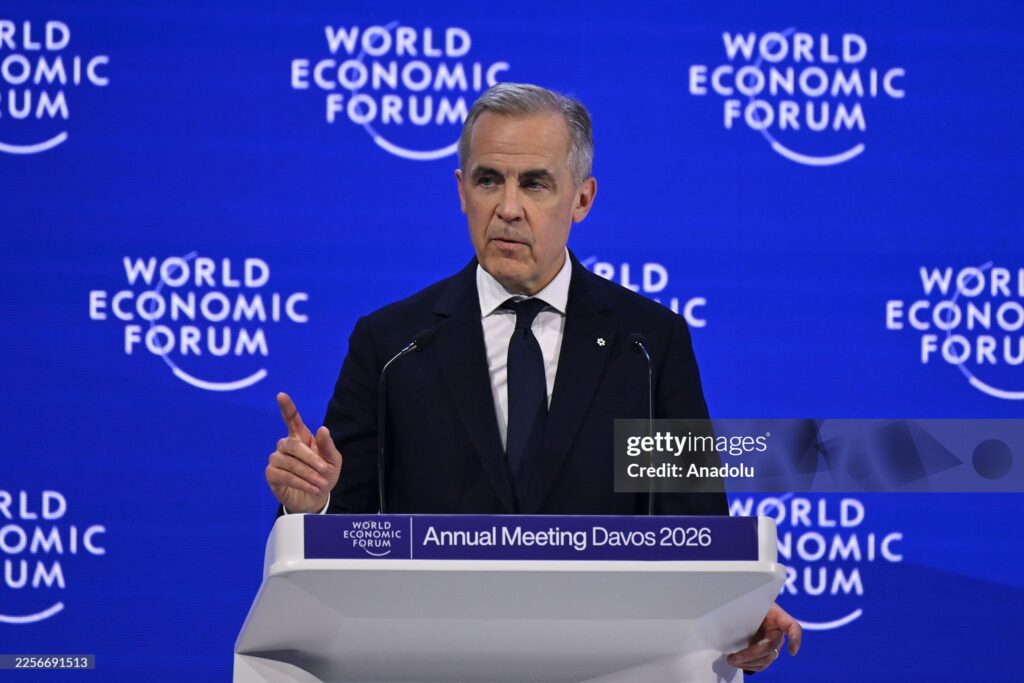
In an era of strategic confusion – where too many leaders speak in foggy generalities, as if ambiguity itself were a form of wisdom – Carney spoke with the precision of someone who understands that history is not a backdrop. It is a force. And right now, history is moving again.
The Old Order Is Not Coming Back
The central insight of his remarks was as sobering as it was necessary: the old order is not returning. Not because we failed to wish hard enough, but because the conditions that sustained it have changed. The world is hardening into blocs, fortresses, and transactional power politics. In such a world, the countries that suffer most are not always the weakest states in absolute terms, but those in the middle – nations that built prosperity through stability, trade, law, and predictable rules.
Carney’s speech was, in effect, a call to these nations: stop waiting for someone else to restore yesterday’s international system. Stop acting as though compliance will buy safety. And above all, stop mistaking nostalgia for strategy.
Thucydides Returns: Power Without Apology
Thucydides saw this logic long before modern institutions, before treaties and summits and declarations. His cold aphorism remains the skeleton key to power politics: “The strong do what they can, and the weak suffer what they must.”
Faced with that grim truth, there is a strong temptation for countries to go along to get along – to accommodate, to avoid trouble, to hope that obedience will purchase protection.
But as Carney warned, it won’t.
This Isn’t A Passing Storm
What we are seeing is not merely about tariffs or territory or rhetoric. It is the return of a worldview: that might makes right, that alliances are optional, that agreements are disposable, that weakness is an invitation, and that smaller countries exist mainly to be leaned on.
This is not a temporary fever. Donald Trump has now been elected twice, and his support remains unwavering among at least a third of the American electorate despite everything that has transpired. That alone shatters the comforting fantasy that the “Trump era” was simply a passing disruption.
Even when Trump is gone, similar politicians – perhaps smoother, perhaps younger, perhaps even more disciplined – will move into the breach. The political demand for strongman certainty is not evaporating; it is being normalized.
The Task Of The Middle Powers
Carney’s Davos speech rejected the illusion that middle countries can survive by staying quiet and staying small. Instead, he offered a more demanding and more hopeful alternative: the middle powers must act together.
Because, as the blunt modern paraphrase puts it: if we’re not at the table, we’re on the menu.
This was the heart of his argument: multilateralism cannot survive on habit. It must be defended through action.
“Geometric Cooperation:” Alliances That Flex And Multiply
Carney described the need for a multilateral alliance built not as a single rigid bloc, but through “geometric” cooperation – flexible, overlapping coalitions of middle powers working together across trade, security, energy, technology, climate resilience, and supply chains.
Not one alliance to rule them all, but a latticework of partnerships that makes coercion harder and cooperation easier.
This is not naive idealism. It is realism for a fractured world.
The Power Of The Powerless – And The Courage To Refuse
Carney’s argument carried the moral undertone of a powerful political idea from the late Cold War: the power of the powerless. Even those without tanks and empires possess leverage – if they coordinate, if they speak plainly, if they refuse to internalize the psychology of fear.
It is not powerlessness that destroys nations. It is resignation.
And resignation often begins quietly – with a sign in the window.
The Sign In The Window
In the communist world, one of the sharpest jokes about survival under dysfunction was the idea that the system endured with a sign in the window – something like: “Workers of the world unite” or “We have everything.” Or perhaps, more honestly: “Pretend.”
Pretend the shelves are full.
Pretend the numbers are real.
Pretend the system is working.
Carney’s message, in essence, was that middle powers must stop pretending.
Stop pretending the rules-based order will automatically repair itself.
Stop pretending bad faith actors will return to good faith.
Stop pretending silence today will spare you trouble tomorrow.
Trouble does not respect silence. It interprets it.
The New Strongman Script
What made the speech particularly striking was the contrast between Carney’s steady clarity and the carnival-mirror rhetoric now common in parts of global politics.
We hear punishment economics dressed up as patriotism: “Instead of raising taxes on domestic producers, we’re lowering them and raising tariffs on foreign nations to pay for the damage that they’ve caused.”
We hear oil-fueled triumphalism: “Every major oil company is coming in with us. It’s amazing. It’s a beautiful thing to say…”
And then there is the language of domination, spoken without embarrassment: “We probably won’t get anything unless I decide to use excessive strength and force where we would be, frankly, unstoppable.”
Or territorial appetite served with legalistic flourish: “All we’re asking for is to get Greenland… because you need the ownership to defend it. You can’t defend it on a lease.”
Even allies are not spared. Gratitude is demanded like tribute: “I watched their Prime Minister yesterday. He wasn’t so grateful… Canada lives because of the United States. Remember that Mark [Carney], the next time you make your statements.”
This is not diplomacy. It is a hierarchy, spoken aloud.
Canada’s Quiet Strength
Carney did not respond with panic, nor with theatrical outrage, nor with the weak comfort of “this too shall pass.” He responded with the calm firmness of a country that knows what it is, and what it stands for.
Canada Is A Pluralistic Society That Works.
Our public square is loud, diverse, and free.
Canadians remain committed to sustainability.
We are stable and reliable in a world that is anything but.
A partner that builds relationships for the long term.
Taking The Sign Out Of The Window
Then came the line that gave the speech its title-worthy force: we are taking the sign out of the window.
No more pretending the old order will return.
No more living off inherited stability.
No more hoping that compliance will buy safety.
The message was not defeatist – it was liberating. Because once you accept that the old order is gone, you can stop mourning and start building.
As Carney put it: “We know the old order is not coming back. We shouldn’t mourn it. Nostalgia is not a strategy.” And then came the turn from realism to resolve: from fracture, we can build something “bigger, better, stronger, more just.”
Building The Table
This is the task of the middle powers: the countries with the most to lose from a world of fortresses, and the most to gain from genuine cooperation.
Davos has heard countless speeches about “shared values” and “global partnership.” Many were sincere. Some were hollow. Carney’s stood out because it treated the world as it is – not as we wish it were – and still insisted that agency remains.
Thucydides was right about the strong and the weak.
But Carney reminded us of the third category: the capable – nations strong enough to matter, if only they act together.
The middle powers do not need to beg for a seat at the table.
They need to build the table.
EDITOR’S NOTE: Ron Cheong, born in Guyana, is a community activist and dedicated volunteer with an extensive international background in banking. Now residing in Toronto, Canada, he is a fellow of the Institute of Canadian Bankers and holds a Bachelor of Science degree from the University of Toronto. His comments are his own and do not reflect those of News Americas or its parent company, ICN.