




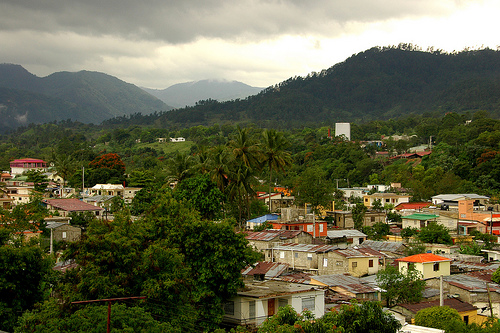
- Jarabacoa in La Vega province in the DR.
News Americas, LONDON, England, Fri. Nov. 6, 2015: One of my abiding memories of travelling in the Dominican Republic is of staying in a remote and beautiful mountainous area above Jarabacoa in La Vega province.
For those who have never had the good fortune to visit the country’s central range of mountains, these are largely lush and tropical, but their high elevation — 525m and more above sea level — means that they have warm days and cool nights for most of the year.
What made this special for me was that I, a visitor, stayed in a house owned by friends that was located in and above a rural community. It was magical. I was in a setting I would never otherwise have visited, enabling me to see something of the real country, see the way of life of a small rural community, understand more about the people, their hardships and happiness, and experience the peace in a way offered to few visitors.
I have had similar experiences in Jamaica, in the mountains in Guatemala, in Dominica when all of the relatively few hotel rooms in Roseau were full, and in St Vincent; but while this may say something about me and my love of mountains and rural life, it also speaks to the challenge of enabling small groups of visitors to travel into a country, stay and experience the reality away from the coast, and to be embraced by the natural.
Although the marketeers would suggest that this is the ‘authentic’ that many visitors, especially well-off young educated professionals are seeking, I am not so sure.
The challenge of course is to know how best rural tourism might be organized without changing the reason for a visitor wanting the experience or in it resulting in unpredictable social consequences in the communities involved.
Despite this, the idea of rural is becoming a new category in the Caribbean visitor offering, although it is less clear how well it is being thought through, or the extent to which, in some minds, it is equated to another new category, agro-tourism.
Agro-tourism refers to travel that combines rural settings with the products of agriculture within a single paid for tourism experience. The idea is that this has as a goal creating revenues for farmers and the surrounding communities.
According to regional experts such as those at the Caribbean Regional Sustainable Tourism Development Programme (IICA) the main components of rural visitor experiences include open sspaces, low levels of urban or industrial development, and the opportunity for the visitor to directly experience agricultural, pastoral, and natural environments, as well as crafts, culinary products and local culture.
The idea reflects a desire to strengthen the link between agriculture and tourism, increasing the value chain for both of the industries, and has been on the region’s political and economic development agenda for a considerable time.
However, this is not the same as rural tourism which regionally Costa Rica is the best exponent of. It has carefully developed a small industry so that it can offer what it describes as ‘the opportunity to access without barriers the essence of the Costa Rican rural life, and to explore natural landscapes and the least visited natural areas … with excellent hosts, while learning from the traditions and way of life of the local population.’
To achieve this it has developed community-based rural tourism initiatives run by community associations that own private ecological reserves or that are close to areas of environmental and cultural interest. The idea is that such communities offer new experiences for visitors while providing services including accommodation, excursions ‘in natural landscapes within the indigenous or Afro-Caribbean cultures of their community.’
To develop the product, the country has established community-based rural tourism associations and co-operatives, and reports suggest now has around some 50 rural tourism projects.
While the appeal of rural vacations will always be limited, and there is a fine line between the experience and voyeurism, these are ideas worth exploring more widely in the Anglophone Caribbean, with the caveat that for rural tourism, local interests must remain paramount.