




News Americas, KINGSTOWN, St. Vincent and the Grenadines, Jan. 29, 2026: St. Vincent and the Grenadines Prime Minister, Dr. Godwin Friday, has laid out his first national budget since taking office – and the figures reveal both ambition and constraint as his administration grapples with rising debt costs, disaster recovery, and tight revenue growth.
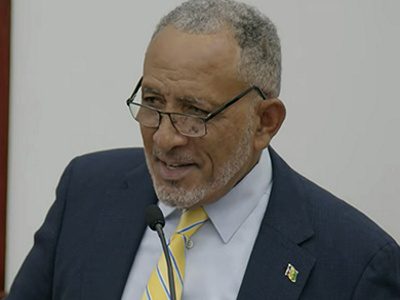
Presenting the 2026 Estimates of Revenue and Expenditure, Friday announced a US$703 million fiscal package, a modest 2% increase over last year’s approved budget, signaling continuity rather than expansion in public spending.
The budget is expected to be financed largely through US$336 million in current revenue and US$362 million in capital receipts, reflecting continued reliance on project-based funding and external inflows rather than organic revenue growth.
A Budget Under Pressure
Recurrent spending for 2026 – excluding debt amortization and sinking fund contributions – is projected at approximately US$374 million, leaving a current deficit of about US$39 million.
“That deficit is not new,” Friday told Parliament, acknowledging that successive administrations have run deficit budgets. “Our challenge is to shrink those deficits over time.”
Revenue projections are slightly weaker this year, driven largely by a sharp 40% drop in non-tax revenue, after the government confirmed there will be no repeat of World Bank reimbursements tied to Hurricane Beryl cleanup under the BERRY Project.
Last year’s budget benefited from a one-off US$7.4 million retroactive reimbursement. That cushion disappears in 2026.
Where the Money Comes From
Tax revenue is projected to reach approximately US$282 million, up marginally by less than 1%. Growth is expected mainly from:
- Taxes on international trade, rising by about US$1.7 million
- Income and profit taxes, climbing roughly 6.5% to US$48 million
Non-tax revenue is forecast at US$53 million, driven largely by government goods and services, expected to generate US$44 million.
Debt Is the Quiet Risk
The most striking pressure point in the budget is debt servicing.
Total recurrent expenditure – including amortization and sinking fund contributions – rises to US$484 million, a 13.7% increase over last year.
Debt amortization alone jumps to US$100 million, up nearly 26%, while sinking fund contributions climb to US$9.3 million. “Amortization is worrying,” Friday admitted — a rare note of candor that underscores the long-term fiscal challenge facing the small island economy.
Wages, Pensions, And Transfers
Public sector compensation increases by US$14.5 million, reflecting wage obligations and staffing costs. Pension payments rise modestly to US$34.6 million, including:
- US$29 million for civil service pensions
- US$5.6 million in government contributions to the National Insurance Services, (NIS)
Transfers for training, grants, and regional obligations rise by about US$10 million, adding further strain to recurrent spending.
Capital Spending Gets Tighter – And More Targeted
Capital spending for 2026 is set at US$213 million, a 17% reduction from last year, reflecting a more restrained public investment program.
Still, key ministries will see significant allocations:
- Transport & Works: US$42.7 million
- Education & Vocational Training: US$23.5 million
- Higher Education, Grenadines Affairs, Ports & Airports: US$29 million
- Finance & Economic Planning: US$70 million
- Housing & Informal Settlements: Nearly US$15 million
The focus, Friday said, will be on roads, sea defenses, schools, clinics, and public buildings, with an emphasis on resilience and essential services rather than large new initiatives.
The Bigger Picture
Friday’s first budget is less about bold expansion than fiscal navigation – balancing debt obligations, disaster recovery, and public expectations in a constrained economic environment.
The message is clear: the new government inherits limited fiscal space, rising debt costs, and fewer one-off supports – and the hard choices are just beginning.